

Key Takeaways
- There is no universal prop firm news-trading rule.
- Challenge-stage and funded-stage news policies may be different.
- High-impact events such as inflation data, employment reports, and central-bank decisions can produce rapid volatility and execution risk.
- A firm may allow you to hold an existing position while restricting new orders around the announcement.
- Some programs allow news trading but change how profits generated around selected announcements are treated.
- News restrictions may apply only to instruments directly affected by the announcement.
- Economic-calendar time zones matter when checking restricted windows.
- Slippage and widening spreads can increase your actual loss even if news trading is permitted.
- Always verify the current rules for the exact program and account type before trading.
You identify a EUR/USD setup five minutes before a major inflation report. Everything looks perfect: your entry is ready, your stop-loss is defined, and the potential risk-to-reward ratio looks attractive. But there is another question you need to answer before placing the trade: Does your prop firm actually allow you to trade during the news event?
There is no universal answer across the proprietary trading industry. Some prop firm programs allow news trading freely. Others restrict opening or closing positions around selected high-impact announcements. Some allow trading during the evaluation but apply different rules once you reach the funded stage. Others permit the trade but modify how news-period profits are treated.
Current official policies illustrate how different these structures can be. FTMO allows unrestricted news trading during its Evaluation Process, but selected restrictions apply to Standard FTMO Accounts; its Swing accounts do not have those news restrictions. FundedNext currently allows news trading during its challenge and funded stages, but certain funded-account programs apply a special News Reward/Profit Split Rule around high-impact events. The5ers also allows news trading under some programs while imposing program-specific restrictions—for example, its High Stakes rules restrict executing orders around certain high-impact events.
For prop traders, therefore, checking the economic calendar is only half the job. You also need to understand how your specific prop firm treats those events. This guide explains what news trading is, why prop firms create news restrictions, how the rules can differ, and what traders should check before placing a position around a major economic release.
Quick Facts
| Topic | Details |
|---|---|
| Category | Prop Firm Basics |
| Difficulty | Beginner |
| Main Topic | Prop firm news trading |
| Best For | Forex, CFD and funded-account traders |
| Search Intent | Informational |
| Last Updated | August 2026 |
What Is News Trading?
News trading refers to opening, closing, or managing positions around economic or market-moving announcements. A trader may intentionally trade the announcement because they expect large price movement, or they may simply have an existing position open when an announcement occurs. These are not necessarily treated the same way under every prop firm rulebook.
Typical economic and market-moving events include:
- Interest-rate decisions by major central banks.
- Inflation reports (Consumer Price Index, PPI, PCE).
- Employment data (U.S. Non-Farm Payrolls, Unemployment Rate).
- Gross Domestic Product (GDP) releases.
- Central-bank speeches and press conferences.
- Retail sales and consumer sentiment figures.
- Purchasing Managers' Index (PMI) releases.
- Unexpected geopolitical or macro developments.
Scheduled announcements can be tracked in an economic calendar. The critical distinction for prop traders is that a firm may define specific restricted events and specific time windows, rather than banning every economic announcement.
Why Economic News Moves Markets
Financial markets continuously price expectations about inflation, interest rates, economic growth, employment, and monetary policy. Suppose traders expect U.S. inflation to come in at 2.5%, but the report is released at 3.2%. That difference can immediately change expectations about future Federal Reserve policy. Currency, index, bond, commodity, and cryptocurrency markets can reprice rapidly.
During this rapid repricing, several market phenomena occur simultaneously:
- Order-book liquidity can drop precipitously as institutional market makers pull back quotes.
- Bid-ask spreads can widen by 5x to 20x standard levels.
- Price can move violently in multiple directions within milliseconds.
- Stop-loss orders may experience severe negative slippage.
- Market orders can execute far away from expected prices.
This is why high-impact economic announcements create both immense opportunity and heightened execution risk for proprietary traders.
Can You Trade News With a Prop Firm?
Sometimes yes, sometimes no, and often: yes, but only under certain specific conditions. There is no industry-wide rule governing news events.
For example, FTMO currently permits unrestricted news trading during its Evaluation Process. Restrictions on selected macroeconomic announcements apply after reaching a Standard FTMO Account, while Swing accounts are exempt from those restrictions. FundedNext currently allows news trading during both challenge and FundedNext Account stages, but its funded-stage treatment can include special profit-sharing rules around high-impact announcements. The5ers states that news trading is allowed generally but prohibits certain practices such as bracket strategies, and some individual programs carry additional rules.
So asking 'Does this prop firm allow news trading?' is rarely specific enough. A comprehensive evaluation checklist must ask:
- Which program and account model?
- Which evaluation stage (Challenge vs Funded)?
- Which specific economic event tier (High Impact / Red Folder)?
- Which currency pair or instrument is affected?
- Which exact time window applies (e.g., 2 minutes or 5 minutes before/after)?
- Which type of action is restricted (Opening, Closing, or Holding)?
Challenge vs Funded Account News Rules
One of the most common beginner mistakes is checking evaluation rules but failing to inspect funded-account rules. They often differ significantly.
| Rule Dimension | Evaluation / Challenge Stage | Funded Account Stage |
|---|---|---|
| News Trading | Allowed in most programs | Frequently restricted or regulated |
| Holding Existing Positions | Allowed | Allowed (with Swing account exceptions) |
| Opening New Trades | Allowed | Restricted around selected high-impact events |
| Closing Trades | Allowed | May be restricted or trigger rule violations |
| Profit Treatment | Standard evaluation target credit | Program-specific profit split or capping rules |
This is not merely theoretical. FTMO currently allows traders to trade freely around news during its Evaluation Process, while restrictions apply to selected releases on Standard FTMO Accounts. FundedNext's Stellar 2-Step documentation similarly states that news trading is allowed during the Challenge, while a News Profit Split Rule applies on the FundedNext Account around specified high-impact announcements. The essential takeaway is simple: The rules you use to pass may not be identical to the rules you use to get paid.
How News Trading Restrictions Work
Proprietary trading firms enforce news policies through several distinct rule mechanisms:
- Complete Restriction: The program strictly prohibits executing any trading action during specified calendar windows.
- Entry Restriction: Traders are prohibited from opening new market or pending positions during the window.
- Exit Restriction: Closing active positions during the relevant window may count as a rule breach.
- Pending Order Restriction: Buy stops, sell stops, and limit orders triggered inside the window are considered violations.
- Instrument-Specific Restriction: Only currencies or assets directly tied to the announcement are locked (e.g., USD pairs for NFP, EUR pairs for ECB).
- Profit Adjustment: Trading remains technically allowed, but profits generated within the restricted window are deducted or subjected to altered splits.
- Strategy Restriction: Ordinary discretionary trading is allowed, but placing simultaneous opposing stop orders (news straddling or bracketing) is explicitly banned.
Which Economic Events Matter Most?
Not every economic calendar release generates explosive volatility. Prop firms and institutional desks concentrate on high-impact announcements that alter interest rate trajectories:
- Central Bank Interest-Rate Decisions: FOMC (Federal Reserve), ECB, BOE, BOJ, and RBA decisions determine benchmark lending rates and broader market liquidity.
- Consumer Price Index (CPI): The foremost inflation metric that directly shifts central bank monetary policy forecasts.
- Employment Reports: U.S. Non-Farm Payrolls (NFP), Average Hourly Earnings, and Unemployment Rates.
- Gross Domestic Product (GDP): Macroeconomic growth figures indicating expansion or impending recession.
- Central Bank Speeches & Press Conferences: Live commentary and forward guidance from central bank governors.
- Retail Sales & Consumer Confidence: Direct gauges of consumer spending capacity and economic vitality.
Example: Trading Around CPI
Imagine U.S. CPI is scheduled for 8:30 AM New York time. You are trading EUR/USD. At 8:25 AM, the market is trading at 1.1000. Your planned setup is: Entry at 1.1002, Stop-Loss at 1.0982 (20 pips risk), Take-Profit at 1.1042 (40 pips reward), giving a clean 1:2 Risk-to-Reward ratio.
At 8:30:00 AM, CPI is released. Price violently whipsaws from 1.1000 to 1.1035, plunges to 1.0990, and then surges to 1.1050 within seconds. Even if your directional thesis was ultimately correct, real execution hazards emerge: your buy order fills 8 pips higher due to slippage; the bid-ask spread widens from 0.2 to 4.5 pips; a temporary downward spike triggers your stop-loss before the rally; or the execution violates a 2-minute news restriction on your funded account.
Existing Positions vs New Orders
A crucial distinction in prop trading compliance is whether a rule prohibits holding an open position or executing an order. Suppose you entered EUR/USD three hours before CPI as part of a multi-day swing trade, and the position is sitting in profit.
Some programs permit holding existing swing positions through news events without penalty. Other programs require all positions in affected currencies to be closed prior to the announcement. Some allow holding but strictly prohibit modifying stop-losses, taking partial profits, or opening new trades during the window. For instance, The5ers' High Stakes documentation allows open positions to be held over high-impact news while restricting order execution during the window. Holding through news and actively trading news are two completely distinct concepts.
News Trading and Slippage
Even when news trading is 100% permitted by a prop firm, market microstructure execution risk remains. Suppose you plan to risk $500 on a trade with a tight stop-loss. During an unexpected NFP print, liquidity evaporates and your stop-loss executes $200 deeper than planned, resulting in a $700 realized loss.
Prop firm risk engines judge accounts strictly by actual realized P&L, not by your intended risk. Fast news spikes can quickly transform planned risk into a fatal rule violation.
News Trading and Maximum Daily Loss
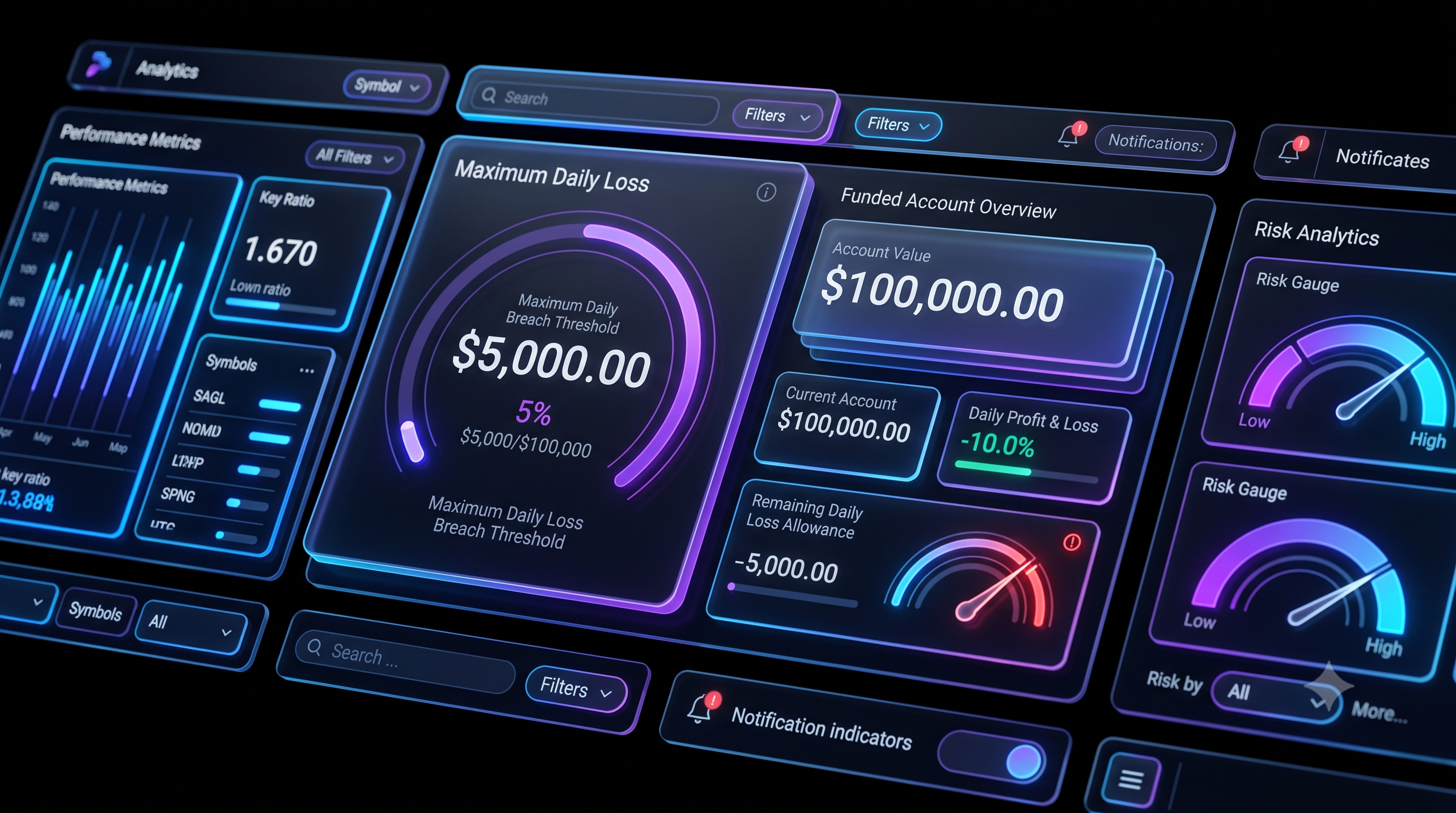
Consider a $100,000 funded account with a 5% Maximum Daily Loss ($5,000 threshold). Suppose you have already incurred $4,300 in closed losses earlier in the day. You spot an attractive high-impact news setup and enter with an intended risk of $500.
Your expected total daily loss would be -$4,800, which is within the $5,000 ceiling. However, upon release, extreme slippage adds $350 to your loss, bringing total daily drawdown to -$5,150. Your account is permanently breached. Operating near maximum drawdown boundaries during volatile economic releases is one of the quickest ways traders lose funded accounts.
Why Do Prop Firms Restrict News Trading?
Prop firms impose news restrictions to protect their liquidity provider relationships, hedging models, and capital reserves. During high-impact releases, simulated bridge execution often cannot match real liquidity fills, leading to toxic flow or extreme variance. Restricting news gambling encourages disciplined, repeatable trading strategies rather than high-stakes coin-flip betting.
News Trading vs News Gambling
There is a fundamental difference between systematic news trading and news gambling. A systematic news trader backtests volatility expansions, uses small position sizes, and accounts for wide spreads. In contrast, a news gambler normally risks 0.5% per trade, but suddenly risks 4% on NFP hoping to double their balance instantly. On prop accounts with strict drawdown limits, that single coin-flip can instantly terminate months of evaluation effort.
How Different Prop Firms Handle News
| Firm / Program Example | Current General Approach |
|---|---|
| FTMO Evaluation | News restriction does not apply during evaluation |
| FTMO Standard Account | Restrictions apply around selected news releases |
| FTMO Swing | No news-trading restriction |
| FundedNext Challenge | News trading allowed |
| FundedNext Funded Stage | News trading allowed, but some programs apply special reward/profit treatment |
| The5ers | News trading generally permitted, subject to program and prohibited-strategy rules |
These examples reflect documented policies as of August 2026. Because prop firm rules evolve periodically, traders should always verify the latest terms for their specific account tier.
How to Trade Around News More Carefully
- Check the Calendar Daily: Review all high-impact (red folder) releases before starting every trading session.
- Check Your Prop Firm's Official Calendar: The firm's proprietary calendar determines restricted events, not third-party websites.
- Verify Server vs Local Time Zones: Ensure your calendar matches your trading platform's exact broker time (e.g., GMT+2 / GMT+3).
- Know the Exact Buffer Window: Confirm whether restrictions apply 2, 5, or 10 minutes before and after the release.
- Reduce Position Sizing: Cut lot sizes by 50% or more during high-volatility sessions to absorb wider spreads.
- Maintain a Safe Drawdown Buffer: Never execute news trades when your account is within 2% of a daily or total loss limit.
- Confirm Holding Permissions: Verify whether your account type (Standard vs Swing) allows holding over economic releases.
- Recheck Rules Upon Getting Funded: Never assume that evaluation freedoms automatically apply to live funded accounts.
Common Beginner Mistakes
- Assuming 'News Trading Allowed' Means No Conditions: Profit caps, bracket bans, and window rules often still apply.
- Checking Rules Only Once: Prop firms update terms; review the rulebook before each new challenge.
- Using Third-Party Calendars Exclusively: Only your prop firm's official event classification determines rule breaches.
- Forgetting Time Zone Conversions: Time zone misunderstandings can inadvertently cause catastrophic violations.
- Confusing Holding with Execution: Being permitted to hold swing trades does not grant permission to enter new orders.
- Ignoring Slippage Impact: Tight stops do not guarantee execution prices in fast markets.
- Using Dual Pending Orders (Bracketing): News straddling strategies are explicitly prohibited by many leading firms.
- Oversizing on High-Impact Releases: Volatility does not enhance predictive accuracy.
- Assuming Challenge Rules Equal Funded Rules: Funded accounts often enforce strict compliance layers.
What to Compare Between Prop Firms
| Feature | What to Check |
|---|---|
| Challenge News Trading | Allowed or restricted during evaluation |
| Funded News Trading | Allowed or restricted upon reaching funded status |
| Restricted Window | Number of minutes before and after announcement |
| Event List | Specific high-impact macro releases included |
| Affected Instruments | Currency and CFD asset coverage |
| Existing Positions | Whether holding open trades is permitted |
| New Orders | Whether entries and pending triggers are restricted |
| Closing Orders | Whether manual exits or TP/SL triggers count as breaches |
| Pending Orders | Rules regarding buy/sell stops and limits |
| News Profit Treatment | Whether profits within the window are subject to altered splits |
| Bracketing / Straddling | Whether simultaneous opposing orders are banned |
| Economic Calendar Source | Official firm-provided calendar data |
| Rule Violation Consequences | Warning, profit cancellation, or immediate account termination |
PropCompareHub Insight
💡 PropCompareHub Insight: Most prop firm comparison tables reduce news rules to a simple Yes/No checkbox. That is increasingly too simplistic. A comprehensive comparison must distinguish Challenge vs Funded News Trading, Restricted Windows, Holding Permissions, and Profit Adjustments. For example, labeling FTMO simply as 'News Trading: No' is misleading because evaluation and Swing accounts permit it, while labeling FundedNext solely as 'News Trading: Yes' misses its funded-stage profit split conditions around high-impact events. Use PropCompareHub to inspect granular, audited rules before choosing your evaluation.
Conclusion
The question 'Does this prop firm allow news trading?' sounds simple, but the real answer requires granular analysis. A program may allow news trading during an evaluation and restrict it after funding. Another may permit trading but adjust how news-period profits are paid out. Another may allow holding existing trades while prohibiting new orders. And another may permit ordinary news trading while strictly banning bracket strategies.
Every prop trader should verify: Program → Stage → Event → Instrument → Time Window → Order Type before trading any major announcement. News trading can be a legitimate, profitable strategy—but on a prop firm account, comprehensive rule awareness is the most critical part of your edge.
Frequently Asked Questions
Related Guides
Prop Firm Payouts Explained: How Do Funded Traders Get Paid?
Learn how prop firm payouts work, including profit splits, payout schedules, withdrawal rules, minimum payouts, and what traders should check before choosing a firm.
What Happens If You Fail a Prop Firm Challenge?
Failed a prop firm challenge? Learn what happens to your account and fee, whether you can retry, how resets work, and what to do before buying another challenge.
Find Your Ideal Prop Firm
Answer a quick question to get personalized firm recommendations tailored to your goals.
Ready to Compare Prop Firms?
Don't settle for the first firm you find. Use our data to find the best conditions for your specific trading strategy.