
Key Takeaways
- Failing a prop firm challenge generally ends that specific evaluation attempt.
- You normally do not owe the advertised account balance after failing.
- Challenge fees are not automatically refundable.
- Reset and retry policies vary between firms and programs.
- Breaching Maximum Daily Loss or Maximum Drawdown is a common reason an evaluation fails.
- Not reaching a target and actually breaching an account rule can be different outcomes.
- Buying another challenge immediately without identifying why the first one failed can repeat the same problem.
- Traders should calculate the real cost of repeated attempts—not just the price of one challenge.
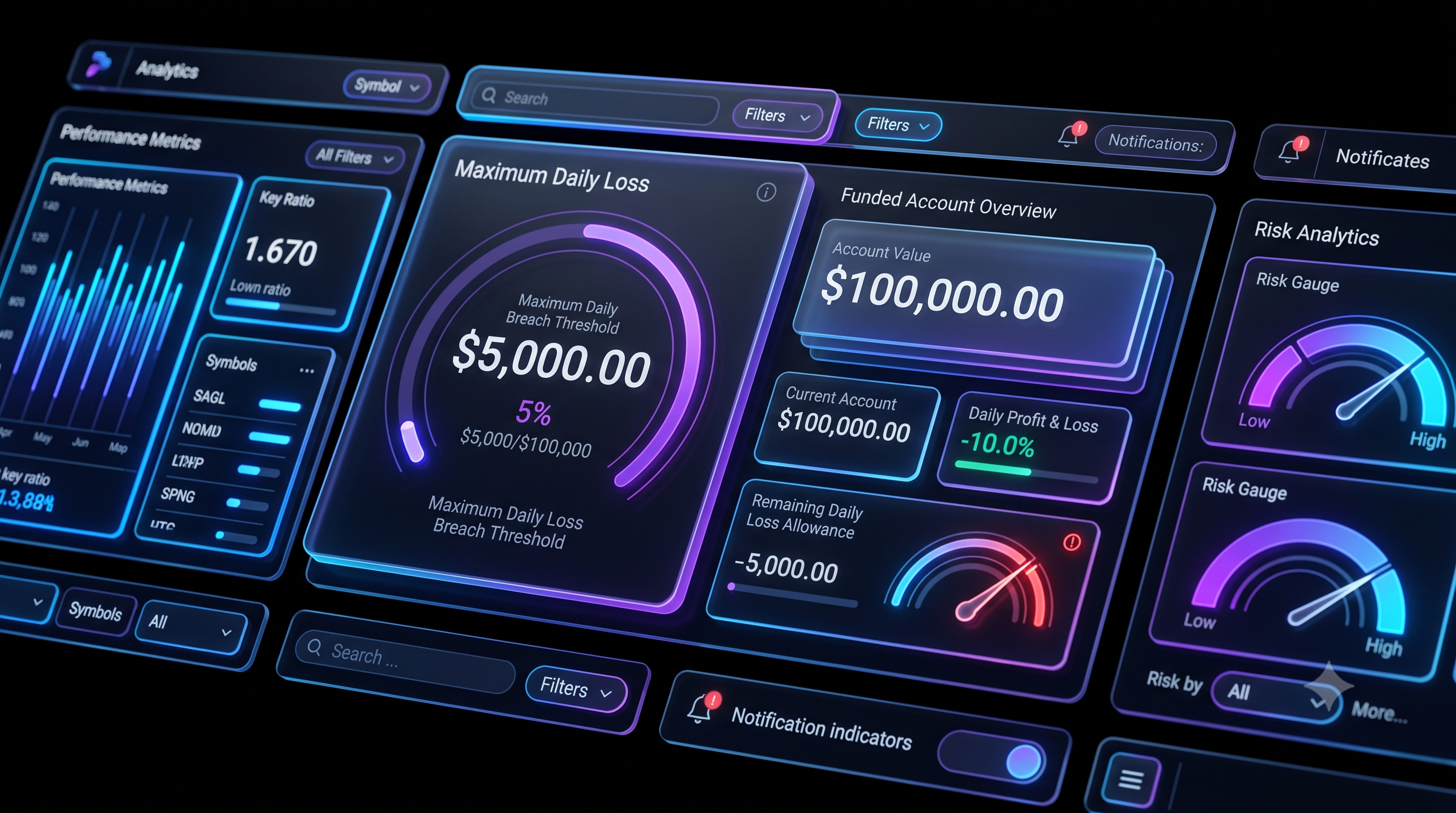
You purchase a $100,000 prop firm challenge. Everything goes well for the first week. Then one bad trading session pushes the account beyond its Maximum Daily Loss.
The dashboard shows: Failed.
What happens now? Do you owe the prop firm money? Can you continue trading? Do you get your challenge fee back? Can you restart the evaluation? And most importantly, should you immediately buy another challenge?
Failing an evaluation is different from losing money in a normal personal brokerage account. The advertised $100,000 account size does not mean you personally owe $100,000 if the evaluation fails. Instead, your access to that evaluation typically ends according to the program's rules.
However, what happens next—including resets, retries, discounts, refunds, or purchasing a new evaluation—depends on the specific prop firm and program.
This guide explains what happens when a prop firm challenge fails, the most common reasons traders fail, and what you should review before attempting another evaluation.
Quick Facts
| Topic | Details |
|---|---|
| Category | Prop Firm Basics |
| Difficulty | Beginner |
| Main Topic | Failed prop firm evaluations |
| Best For | New and unsuccessful challenge traders |
| Search Intent | Informational |
| Last Updated | August 2026 |
What Does It Mean to Fail a Prop Firm Challenge?
A prop firm evaluation usually has several objectives and risk limits. A simplified challenge could include: Starting Balance of $100,000, Profit Target of 8%, Maximum Daily Loss of 5%, and Maximum Drawdown of 10%.
Your objective is not simply: Make $8,000. It is: Reach the required profit while remaining within every applicable rule.
If you violate a rule classified by the program as a hard breach, your evaluation can fail. Depending on the provider, your dashboard may show terms such as Failed, Breached, Disqualified, or Account Terminated.
The exact terminology varies, but the practical result is usually similar: that evaluation attempt can no longer progress toward funding.
What Happens Immediately After You Fail?
The exact process depends on the provider. Typically, one or more of the following happens:
- Trading access is disabled on the evaluation credentials.
- The evaluation is marked as failed on your client portal dashboard.
- The account can no longer progress to the next phase or live funded status.
- You may receive an automated email or notification explaining which specific risk rule was breached.
- A reset or discounted retry option may become available in the dashboard.
- You may need to purchase another challenge to start a fresh evaluation.
This is why checking your dashboard after a failure is useful. Don't immediately rush to purchase another evaluation. First determine: Which rule caused the failure? If you don't know what happened, you can't correct it.
Do You Lose $100,000 If You Fail a $100K Challenge?
No. This is one of the most important beginner misconceptions.
If you purchase a $100,000 evaluation, you have not personally deposited $100,000 into the account. The advertised amount represents the nominal simulated account size used within the program.
Suppose: Challenge price is $500, Account size is $100,000. You breach the Maximum Drawdown and fail. You do not owe $100,000 or $10,000 of drawdown to the prop firm.
Your direct financial cost is generally associated with the evaluation fee and any additional optional add-ons or services you choose, subject to the provider's terms. This is one of the fundamental differences between a prop firm evaluation and trading your own $100,000 personal brokerage account.
Do You Lose Your Challenge Fee?
Often, the original evaluation fee is not automatically refunded simply because the trader fails. Suppose you pay $400 for an evaluation. You breach a rule on Day 6. The evaluation ends. That does not generally mean the $400 automatically returns to you.
However, refund and pricing policies vary significantly across the industry:
- Refund Upon Payout: Many top-tier prop firms refund 100% of your evaluation fee together with your first successful profit split payout.
- Discounted Retries & Resets: Some firms provide a 10% to 50% discount on resets if an account breaches during an active challenge.
- Free Retries on Unbroken Accounts: Legacy programs with time limits sometimes offered free retries if you ended with positive profit without hitting the profit target.
These are commercial policies rather than universal prop trading rules. Always read the current terms before purchasing.
Can You Retry a Prop Firm Challenge?
Potentially. There are several ways firms may structure another attempt:
- New Challenge: You purchase another evaluation and start from the beginning with brand new credentials.
- Reset: You pay a reset-related fee or use an available reset option to restart according to the program's conditions.
- Free Retry: Some programs may offer another evaluation under specific eligibility requirements (such as finishing positive on a timed challenge).
- Promotional Retry: A firm might provide discounted retries or replacement codes during special promotional campaigns.
The critical takeaway: Retry does not always mean free retry. Read the specific conditions carefully.
What Is a Prop Firm Reset?
A reset generally allows a trader to restart an evaluation rather than continuing from the current failed or damaged account state.
Imagine: Starting Balance of $100,000. Current Balance is $92,500. You're approaching the account's maximum loss threshold. Instead of continuing or buying a full-price challenge, a program might provide a reset option that returns the evaluation to its initial conditions according to its terms.
A reset restores: Balance to $100,000, Profit Target Progress to 0%, and Drawdown Status to its initial baseline state. But whether resets are available, what they cost, and when they can be used vary by provider.
Reset vs New Challenge
Beginners sometimes assume an account reset and a new challenge are identical. They frequently differ in price, account state, and discount eligibility:
| Feature | Reset | New Challenge |
|---|---|---|
| Price | $250 (Discounted) | $400 (Full Price) |
| Starting Balance | $100K Restored | $100K New Account |
| Profit Progress | Reset to 0% | Starts at 0% |
| Existing Account | Restarted on same credentials | New evaluation credentials issued |
| Promotional Discount | Usually fixed internal fee | Eligible for promo & coupon codes |
If the reset costs significantly less, it may appear attractive. But there's a more important question: Why did you fail? If the answer is 'I risked 3% per trade and hit the drawdown limit', then resetting the account without changing the strategy may simply create another $250 loss.
Most Common Reasons Traders Fail
There are many ways an evaluation can end unsuccessfully in prop trading:
- Maximum Daily Loss: The trader loses more than permitted within the firm's daily-loss calculation window.
- Maximum Drawdown: The account equity or balance reaches or crosses the overall absolute loss threshold.
- Trailing Drawdown: The permitted loss floor moves upward as the account reaches new highs and the trader later falls below it.
- Prohibited Strategy: The trader uses restricted approaches such as latency arbitrage, grid hedging, or account sharing.
- News Trading Violation: A trade is executed or held during a restricted macroeconomic announcement window.
- Position or Exposure Limit: The trader exceeds an applicable lot-size or margin-exposure rule.
- Consistency Violation: A single trading day or position generates a disproportionate share of the required profit in consistency-enforced programs.
- Inactivity: An account remains inactive without placing a trade for 30 to 60 consecutive days.
- Evaluation Deadline: For legacy programs with a maximum completion period, failing to hit the target within permitted days.
Example: Maximum Daily Loss Failure
Suppose a hypothetical account has: Starting Balance of $100,000 and Maximum Daily Loss of 5% ($5,000 daily loss allowance).
Your session results unfold as follows: Trade 1: -$1,500. Trade 2: -$1,000. Trade 3: -$1,200. Total accumulated loss is -$3,700.
You're frustrated and want to make back the losses immediately. You take one larger trade risking $1,500. It loses. Total daily loss reaches -$5,200.
Under this simplified example, you've exceeded the $5,000 threshold. The account fails immediately. Notice the important insight: The first three losses did not necessarily destroy the evaluation. The emotional decision to increase risk after those losses did.
Example: Maximum Drawdown Failure
Consider: Account of $100,000 with a simplified Maximum Drawdown of 10% (loss threshold at $90,000).
Your account balance gradually falls over several weeks: Week 1: $98,000. Week 2: $95,500. Week 3: $92,000. You now have only $2,000 of simplified room remaining.
Instead of reducing risk, you continue risking $1,000 per trade. Two consecutive full losses immediately put the account at the disqualification threshold.
The problem isn't necessarily that your trading strategy experienced a normal losing period. The problem is that your position sizing failed to adjust to the shrinking drawdown buffer.
What If You Simply Don't Reach the Profit Target?
Not reaching the target immediately does not necessarily mean you've failed.
Suppose your evaluation requires an 8% profit target. After four weeks of trading, you're at +3%. If the program has no restrictive maximum evaluation deadline (unlimited trading days) and you've followed all applicable rules, the evaluation remains fully active.
This is a fundamental distinction every trader must keep in mind:
- Slow Progress: Account is completely valid and active. No breach has occurred.
- Rule Breach: Evaluation is immediately terminated or disqualified.
Beginners sometimes create unnecessary psychological pressure because they believe 'If I don't pass quickly, I'm failing.' That's not true. If the program allows sufficient time, slow and steady progress is infinitely better than fast failure.
Should You Buy Another Challenge Immediately?
This is where repeated challenge spending can quickly become expensive. Imagine you fail at 10:00 AM. At 10:15 AM, you purchase another challenge. What changed? Your strategy? No. Your risk model? No. Your emotional state? Possibly worse. The only thing that changed is: You paid another fee.
Before buying another evaluation, review the failed attempt honestly and ask:
- Did my core strategy fail, or did I break my own trading rules?
- Was my risk per trade too large for the account's drawdown constraints?
- Did a single bad trading day or session cause most of the damage?
- Did I engage in revenge trading after an early loss?
- Did I misunderstand a specific rule (such as trailing drawdown or equity calculation)?
- Was I trading too close to a high-impact news event?
- Did I increase position size near the profit target in a rush to finish?
- Was the challenge structure fundamentally unsuitable for my trading style?
Your answers to these questions should determine whether another attempt makes sense right now.
The Hidden Cost of Repeated Challenge Attempts
A $150 challenge sounds inexpensive on its own. But repeated attempts change the overall economics dramatically.
Suppose: Challenge Fee is $150. You attempt it 8 times without fixing your process ($1,200 total spending). On attempt #9, you pass and receive a $1,500 payout.
Your headline payout is $1,500. But your simplified net result relative to challenge spending is only $300 ($1,500 - $1,200 = $300) before considering other costs. This is why disciplined traders track Total Evaluation Spending, not merely the latest challenge price.
Calculate Your Real Prop Firm Cost
Consider maintaining a simple challenge ledger in your trading journal:
| Attempt | Fee | Result |
|---|---|---|
| #1 | $150 | Failed (Daily Loss) |
| #2 | $150 | Failed (Drawdown) |
| #3 | $150 | Failed (Revenge Trade) |
| #4 | $150 | Passed & Funded |
| Total | $600 | Funded |
Later, when you earn your first payout of $900, your simplified net profit after challenge spending is $300 ($900 - $600). This gives you a much clearer picture of whether your prop trading activity is economically worthwhile.
How to Review a Failed Challenge
Before trying again, perform a basic failure audit across six systematic steps:
- Step 1: Identify the Exact Breach: Don't write 'I lost'. Write 'I breached Maximum Daily Loss after four trades on EUR/USD'. Specific problems can be diagnosed and fixed.
- Step 2: Find the Largest Losing Session: Identify if one single day was responsible for 70%+ of the total damage.
- Step 3: Review Position Sizes: Verify whether your lot sizes remained mathematically consistent or spiked when losing.
- Step 4: Compare Planned vs Actual Trades: Determine whether losing trades were valid playbook setups or impulsive deviations.
- Step 5: Review Emotional Trades: Audit your journal for revenge trades, FOMO entries, and unplanned news bets.
- Step 6: Review the Program: Perhaps your strategy simply doesn't fit the firm's rules. A swing trader will struggle with weekend restrictions; a high-frequency scalper will struggle with high spreads.
Failure isn't always solely about strategy quality. Sometimes the challenge rules themselves are a poor match for your trading style.
How to Reduce the Chance of Failing Again
- Use a Personal Daily Loss Limit: Don't use the firm's maximum as your normal risk budget. If the firm permits 5%, set your personal stop at 1.5%–2% per day.
- Reduce Risk After Drawdown: Your position sizing should recognize that your remaining buffer has decreased. Cut lot sizes in half when in drawdown.
- Stop Revenge Trading: One failed session should not become five failed sessions. Implement a mandatory cooling-off period.
- Know Every Hard Rule: Read the program conditions thoroughly before placing your first trade.
- Use Consistent Position Sizing: Avoid dramatically increasing risk because you're behind or want to pass quickly.
- Don't Chase the Profit Target: Being at +7% of an 8% target doesn't make the next setup more likely to win. Wait for quality.
- Track Evaluation Spending: Knowing how much you've spent across attempts prevents challenge buying from becoming an impulsive habit.
What to Compare Before Your Next Challenge
If you're choosing another evaluation, compare these essential parameters across top prop firms:
| Feature | Why It Matters |
|---|---|
| Challenge Fee | Cost per attempt |
| Reset Cost | Cost of restarting an active account |
| Retry Policy | Conditions for another attempt |
| Profit Target | Required return (e.g. 6% to 10%) |
| Maximum Daily Loss | Daily risk capacity (static vs equity-based) |
| Maximum Drawdown | Overall risk capacity (8% to 12%) |
| Drawdown Type | Static balance-based vs trailing equity-based |
| Minimum Trading Days | Earliest possible completion timeline |
| Time Limit | Unlimited duration vs fixed expiration deadlines |
| News Rules | Strategy compatibility with high-impact releases |
| Holding Rules | Overnight and weekend holding permissions |
| Consistency Rules | Profit distribution rules and lot consistency |
| Payout Policy | Speed of withdrawals and refundable fee timeline |
The cheapest challenge isn't necessarily the cheapest path to funding. A slightly more expensive evaluation that fits your strategy may cost less over multiple attempts.
PropCompareHub Insight
💡 PropCompareHub Insight: Prop firm comparison pages usually focus on headline Challenge Price. But traders should also evaluate the 'Expected Cost to Reach Funding'. Imagine Firm A costs $100 per challenge with tight rules, taking 5 attempts ($500 total). Firm B costs $180 with generous static drawdown, taking 2 attempts ($360 total). Firm B had the more expensive challenge sticker price, but your actual path to funding was $140 cheaper. Don't optimize only for the lowest entry fee—optimize for the challenge structure that best matches your strategy and risk profile.
Conclusion
Failing a prop firm challenge does not mean you've lost the advertised account balance. But it can still become expensive if not managed carefully.
The real danger is not one failed evaluation. It is the uncorrected cycle: Fail → Buy Again → Repeat Same Behavior → Fail Again.
Instead, treat every failed challenge as valuable data. Identify which rule failed, which trade caused the damage, whether the problem was strategy, risk, psychology, or rule misunderstanding, and whether this prop firm actually fits the way you trade.
A new challenge gives you a new account. It does not automatically give you a new trading process. Fix the process first, then try again.
Frequently Asked Questions
Related Guides

Prop Firm Payouts Explained: How Do Funded Traders Get Paid?
Learn how prop firm payouts work, including profit splits, payout schedules, withdrawal rules, minimum payouts, and what traders should check before choosing a firm.
What Is Slippage in Trading? A Prop Trader's Guide
Learn what slippage is, why trades can execute at different prices, how volatility and news affect slippage, and how prop traders can reduce execution risk.
Find Your Ideal Prop Firm
Answer a quick question to get personalized firm recommendations tailored to your goals.
Ready to Compare Prop Firms?
Don't settle for the first firm you find. Use our data to find the best conditions for your specific trading strategy.