

Key Takeaways
- A prop firm provides traders with access to firm capital instead of requiring them to trade only personal funds.
- Most online prop firms require traders to pass an evaluation or challenge before receiving a funded account.
- Traders earn a percentage of profits, commonly called a profit split.
- Risk rules such as daily loss limits, maximum drawdown, and consistency rules are often more important than profit targets.
- Prop firms can be useful for disciplined traders, but they are not a shortcut for beginners without a tested strategy.
- Before joining, traders should compare fees, rules, platforms, payout policies, and firm reputation.
A prop firm, short for proprietary trading firm, is a company that gives traders access to trading capital. Instead of trading only with their own money, traders can qualify for a funded account and trade using capital provided by the firm.
For many retail traders, this is attractive because it offers a way to access larger account sizes without depositing tens of thousands of dollars into a personal trading account. In return, the trader usually shares a percentage of profits with the firm and must follow strict risk management rules.
This guide explains what prop firms are, how they work, how they make money, what a prop firm challenge is, and what beginners should check before joining one.
What Is a Prop Firm?
A proprietary trading firm is a company that uses its own capital to trade financial markets. In traditional finance, prop trading desks may trade stocks, futures, options, forex, or other instruments using company money.
In the retail trading world, the term "prop firm" usually refers to online funded trader programs. These firms allow individual traders to apply for a trading account by completing an evaluation process. If the trader meets the firm’s rules, they may receive access to a funded account.
The basic idea is simple:
- The trader provides the skill.
- The firm provides the capital.
- Profits are shared between both sides.
For example, a trader may pay an evaluation fee for a $100,000 challenge. If they pass the rules, they may receive a funded account and keep 80% to 90% of eligible profits, depending on the firm’s payout structure.
However, prop firm trading is not the same as receiving free money. Traders must follow the firm’s rules carefully. Breaking a daily loss limit, exceeding maximum drawdown, using a prohibited strategy, or violating payout conditions can result in account failure.

How Does a Prop Firm Work?
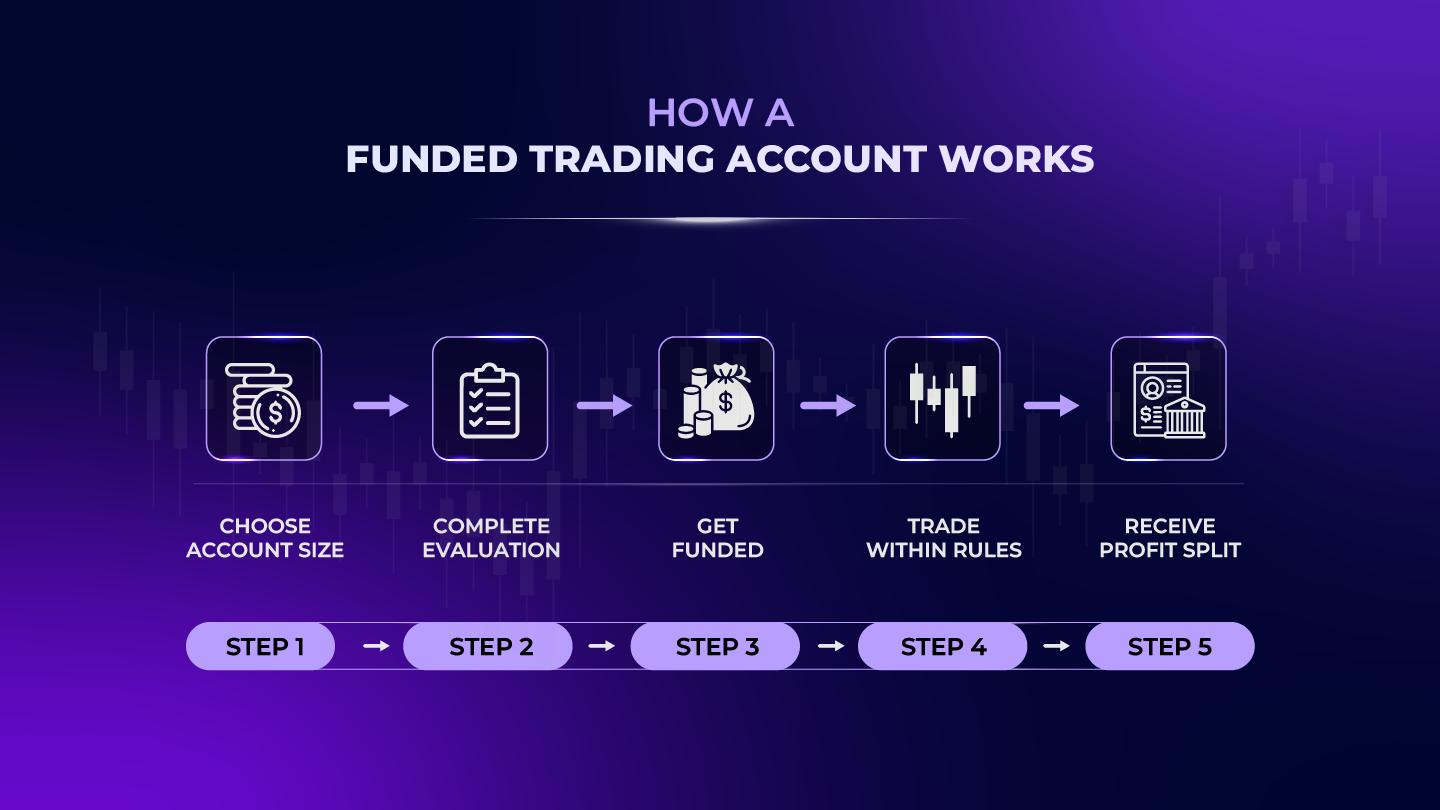
Most modern online prop firms follow a similar process.
- The trader chooses a firm.
- The trader selects an account size.
- The trader pays an evaluation or challenge fee.
- The trader completes the challenge while following rules.
- If successful, the trader receives a funded account.
- The trader earns profits and receives payouts based on the firm’s profit split.
- Some firms offer scaling plans for consistent traders.
Example:
A trader chooses a $100,000 evaluation account. The challenge requires:
- Profit Target: 8%
- Daily Loss Limit: 5%
- Maximum Drawdown: 10%
- Minimum Trading Days: 5 days
- Profit Split After Funding: 80%
If the trader reaches the profit target without violating the loss limits, they may pass the evaluation. Once funded, they can request payouts according to the firm’s payout schedule.
The exact rules vary significantly between firms. This is why comparing prop firms before buying a challenge is important.

Traditional Prop Firms vs Online Prop Firms
Not all prop firms operate the same way. There is an important difference between traditional proprietary trading firms and online funded trader programs.
- Traditional Prop Firm: Often professional or in-house traders, internal company capital, interviews/tests/training hiring process, office or remote, usually no public challenge fee, internal risk desk rules, markets include stocks/futures/options/forex.
- Online Prop Firm: Retail traders worldwide, often evaluation-based funded accounts, online challenge or instant funding model, usually remote, often requires evaluation fee, published challenge rules, markets include forex/indices/commodities/crypto/futures.
Most beginners searching for prop firms are referring to online funded trader programs rather than institutional trading desks.
What Is a Prop Firm Challenge?
A prop firm challenge is an evaluation designed to test whether a trader can generate profit while managing risk.
The challenge usually includes rules such as:
- Profit target
- Maximum daily loss
- Maximum overall drawdown
- Minimum trading days
- Maximum trading days, if applicable
- News trading restrictions
- Weekend or overnight holding rules
- Lot size or risk limits
- Consistency rules
A common beginner mistake is focusing only on the profit target. In reality, the loss rules are often more important. Many traders fail not because they cannot make profitable trades, but because they take too much risk and violate drawdown limits.
For example, if a challenge has a 10% profit target and a 5% daily loss limit, the trader cannot simply use oversized positions to reach the target quickly. One bad trading day could fail the account.
What Is a Funded Trading Account?
A funded trading account is an account provided by a prop firm after the trader meets the required conditions.
The account may be live, simulated, or connected to a risk management system depending on the firm’s model. Traders should always read the firm’s terms to understand whether they are trading live capital, simulated capital, or a copied execution model.
A funded account usually comes with rules. These may include:
- Maximum daily loss
- Maximum drawdown
- Minimum payout requirements
- Profit split percentage
- Trading platform restrictions
- Prohibited trading strategies
- Inactivity rules
- Account scaling rules
The account size shown by the firm does not mean the trader receives that amount as cash. A $100,000 funded account means the trader can trade according to rules based on that notional account size. The trader does not own the full $100,000.
How Do Prop Firms Make Money?
Prop firms can make money in several ways.
- Evaluation Fees: Traders pay to enter challenges or evaluations.
- Profit Sharing: The firm keeps a percentage of trader profits.
- Reset Fees: Some firms charge traders to restart failed challenges.
- Scaling Programs: Successful traders may move to larger accounts with adjusted terms.
- Add-ons: Some firms sell optional features such as higher profit splits or relaxed rules.
A sustainable prop firm should ideally benefit when skilled traders succeed. If a firm relies only on failed challenge fees and has unclear payout terms, traders should be cautious.
PropCompareHub Insight
PropCompareHub Insight: The best prop firm for a beginner is not always the one with the cheapest challenge fee or highest advertised profit split. A slightly more expensive challenge with clear rules, fair drawdown, reliable payouts, and strong support may be better than a cheap account with confusing restrictions.
Profit Split Explained
Profit split is the percentage of trading profit paid to the trader after eligible profits are generated.
For example: If a trader makes $5,000 in eligible profit and the firm offers an 80% profit split, the trader's share is $4,000 and the firm's share is $1,000.
Some firms advertise profit splits of 80%, 90%, or even 100% under certain conditions. However, traders should check the details carefully.
Important questions include:
- Is the high profit split available immediately?
- Does it require an add-on fee?
- Does it apply only after several payouts?
- Are there minimum profit requirements before withdrawal?
- Are there consistency rules that affect payouts?
The headline profit split is only one part of the full payout structure.

Drawdown Rules Explained
Drawdown is one of the most important prop firm concepts for beginners to understand.
Drawdown refers to how much an account can decline from a starting balance, peak balance, or daily balance before the account violates the rules.
Common drawdown types include:
- Daily Loss Limit: Maximum amount you can lose in one trading day.
- Maximum Overall Drawdown: Maximum total loss allowed on the account.
- Static Drawdown: Loss limit stays fixed from the starting balance.
- Trailing Drawdown: Loss limit moves upward as the account grows.
- Relative Drawdown: Loss limit may be calculated based on account equity or balance.
Example:
A $100,000 account with a 10% maximum drawdown may fail if the account falls to $90,000, depending on the firm’s rules.
A $100,000 account with a 5% daily loss limit may fail if the trader loses $5,000 in one day.
Traders should check whether drawdown is calculated based on balance, equity, open trades, closed trades, or end-of-day values. This detail can make a major difference.
Prop Firm vs Personal Trading
Prop firms may reduce the need for large personal capital, but they also reduce flexibility. Personal trading gives more control, but the trader carries the full financial risk.
Neither model is automatically better. The right choice depends on your strategy, risk tolerance, experience level, and trading discipline.
Advantages of Prop Firms
Prop firms can offer several benefits for traders.
- Access to Larger Capital: Traders can work with larger account sizes than they may personally afford.
- Limited Personal Exposure: The main upfront risk is often the challenge fee.
- Structured Risk Rules: Rules can help traders build discipline.
- Scaling Opportunities: Consistent traders may qualify for larger accounts.
- Performance-Based Growth: Skilled traders can potentially earn payouts without depositing large personal capital.
For disciplined traders, a prop firm can be a useful way to test skill under structured conditions.
Disadvantages of Prop Firms
Prop firms also come with disadvantages.
- Evaluation Fees: Fees are usually lost if the trader fails.
- Strict Rules: Small mistakes can fail an account.
- Payout Conditions: Some firms have minimum days, profit thresholds, or consistency rules.
- Strategy Restrictions: News trading, overnight holding, or certain styles may be restricted.
- Firm Risk: Poorly managed firms may delay payouts or change rules.
Beginners should avoid treating prop firms as an easy income opportunity. Passing a challenge requires planning, emotional control, and strong risk management.
Who Should Join a Prop Firm?
A prop firm may be suitable for traders who:
- Already have a tested trading strategy
- Understand risk management
- Can follow strict rules
- Do not want to deposit large personal capital
- Are comfortable with evaluation pressure
- Can accept losing the challenge fee if they fail
A good candidate is not necessarily the trader with the most aggressive return target. It is usually the trader who can trade consistently without breaking rules.
Who Should Avoid Prop Firms?
Prop firms may not be suitable for traders who:
- Are completely new to trading
- Do not understand leverage
- Have no risk management plan
- Revenge trade after losses
- Increase position sizes emotionally
- Do not read terms and conditions
- Expect guaranteed payouts
If you are still learning basic trading concepts, it may be better to practice on a demo account before paying for a challenge.
Example of a Typical Funding Journey
Here is a simplified example. A trader chooses a $50,000 prop firm challenge. The rules are: Profit Target 8%, Daily Loss Limit 4%, Maximum Drawdown 8%, Minimum Trading Days 5, Profit Split 80%.
The trader needs to make $4,000 in profit to pass the challenge. However, they cannot lose more than $2,000 in one day or $4,000 overall.
Instead of risking 3% to 5% per trade, the trader risks 0.5% to 1% per trade. This gives them more room to survive losing streaks.
This is the mindset beginners need to understand: the goal is not just to pass quickly. The goal is to pass without breaking the account.
Common Misconceptions About Prop Firms
Misconception 1: A funded account means the money is yours
A funded account does not mean the firm transfers the full account size to your bank. It means you are allowed to trade under the firm’s account structure and rules.
Misconception 2: The highest profit split is always best
A 90% profit split may look attractive, but payout rules, drawdown limits, and trading restrictions matter just as much.
Misconception 3: Prop firms are easy income
Prop firm trading still involves market risk, emotional pressure, and strict evaluation rules. There is no guaranteed income.
Misconception 4: All prop firms are the same
Rules vary widely. Two firms may offer the same account size but have completely different drawdown rules, payout schedules, and platform options.
Misconception 5: Beginners should start with the largest account
Large accounts can create more psychological pressure. Beginners may be better off starting with a smaller account size while learning the process.
Common Mistakes Beginners Make
- Ignoring drawdown rules: Many traders read the profit target but do not fully understand daily loss and maximum drawdown.
- Overtrading: Taking too many trades often leads to emotional decisions and unnecessary losses.
- Using oversized positions: Large lot sizes may help reach the profit target faster, but they also increase the chance of failing quickly.
- Choosing a firm only by price: The cheapest challenge is not always the best value.
- Not checking payout rules: Some traders pass the challenge but later discover payout conditions they did not understand.
- Trading during restricted news events: If a firm restricts news trading, violating this rule can affect the account.
- Switching strategies during the challenge: Changing systems under pressure usually leads to inconsistent execution.
Pro Tip
Pro Tip for Beginners: Before buying a challenge, write down the exact rules in a simple checklist. Include daily loss limit, maximum drawdown, profit target, minimum trading days, payout rules, news trading rules, weekend holding rules, and maximum lot size. If you cannot explain the rules clearly, you are not ready to trade the challenge yet.
Frequently Asked Questions
Related Guides

What Is a Profit Split in Prop Trading? How It Works (2026 Guide)
Learn how profit splits work in prop trading, how traders get paid, what percentages are common, and what to compare before choosing a prop firm.
How Do Prop Firm Challenges Work? Complete Beginner Guide (2026)
Learn how prop firm challenges work, why firms use evaluations, common challenge rules, and how to improve your chances of passing a funded trading assessment.
Find Your Ideal Prop Firm
Answer a quick question to get personalized firm recommendations tailored to your goals.
Ready to Compare Prop Firms?
Don't settle for the first firm you find. Use our data to find the best conditions for your specific trading strategy.