
Key Takeaways
- Breakouts occur when price moves beyond key support or resistance levels.
- Strong breakouts are often supported by increased momentum or volume.
- Waiting for confirmation can reduce false signals.
- Risk management is more important than predicting every breakout correctly.
- A consistent breakout strategy works best when combined with clear trading rules.
One of the most popular trading strategies among both retail and professional traders is breakout trading.
Instead of trying to predict market reversals, breakout traders wait for price to move beyond an important support or resistance level before entering a trade. When a genuine breakout occurs, it can signal the start of a strong trend and provide favorable risk-to-reward opportunities.
However, not every breakout succeeds. False breakouts are common, especially around major economic news and low-liquidity trading sessions.
In this guide, you'll learn how breakout trading works, how to identify quality setups, and how to manage risk when trading prop firm accounts.
What Is Breakout Trading?
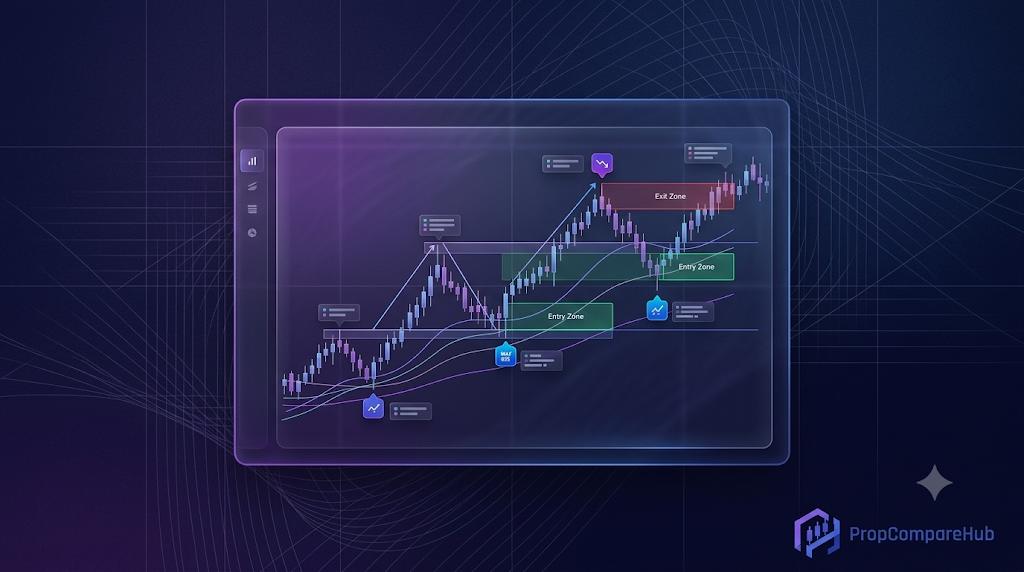
A breakout occurs when price moves beyond an established support or resistance level with enough momentum to suggest a new trend may be developing.
Common breakout situations include:
- Price breaking above resistance.
- Price breaking below support.
- Breakouts from consolidation ranges.
- Breakouts from chart patterns such as triangles, flags, or rectangles.
The objective is to participate in the early stages of a larger market move.
Why Breakouts Happen
Breakouts often occur when buying or selling pressure overwhelms the existing balance between buyers and sellers.
Common catalysts include:
- Major economic news releases.
- Central bank announcements.
- High-impact earnings reports.
- Strong market sentiment.
- Increased trading volume during major market sessions.
These events can trigger rapid price movement as pending orders are executed.
How to Identify High-Quality Breakouts
Before entering a breakout trade, consider the following checklist:
- Strong Support or Resistance: The level should have been tested multiple times.
- Market Structure: Breakouts following a period of consolidation often produce stronger moves.
- Confirmation: Many traders wait for a candle to close beyond the breakout level rather than entering immediately.
- Risk-to-Reward: Ensure your planned reward justifies the risk before placing the trade.
False Breakouts Explained
Not every breakout leads to a trend.
A false breakout happens when price briefly moves beyond a key level before quickly reversing.
Common warning signs include:
- Weak momentum.
- Immediate rejection candles.
- Low trading volume.
- Trading during quiet market sessions.
- Entering before candle confirmation.
Learning to avoid false breakouts is often more valuable than finding more trade opportunities.
Example Trade Setup
Imagine EUR/USD has traded between 1.1200 and 1.1250 for several hours.
A bullish breakout occurs when price closes above 1.1250 with strong momentum.
Example trade plan:
- Entry: 1.1255
- Stop-Loss: 1.1235
- Take-Profit: 1.1295
- Risk-to-Reward: 1:2
Rather than chasing the move, the trader follows a predefined plan with controlled risk.
Risk Management Tips
Even the best breakout setups can fail.
To protect your account:
- Risk only a small percentage of your account per trade.
- Define your stop-loss before entering.
- Avoid moving your stop-loss further away after entry.
- Don't chase a breakout that has already moved significantly.
- Consider avoiding high-impact news if it isn't part of your strategy.
Consistency matters more than catching every breakout.
Common Mistakes
PropCompareHub Insight
PropCompareHub Insight: Many traders believe breakout trading is about being the first to enter the market. Professional traders often prioritize confirmation over speed. Missing a small part of the move is usually preferable to entering a false breakout that results in an unnecessary loss.
Conclusion
Breakout trading is one of the most versatile strategies available to prop traders because it focuses on trading momentum rather than predicting reversals.
The key to long-term success isn't identifying every breakout—it's selecting high-quality opportunities, managing risk consistently, and avoiding emotional decisions after entering a trade.
With patience and a structured trading plan, breakout trading can become a valuable part of your overall trading approach.
Frequently Asked Questions
Related Guides

Risk-to-Reward Ratio Explained: The Complete Guide for Prop Traders (2026)
Learn what the risk-to-reward ratio is, how to calculate it, why it matters in prop trading, and how using the right R:R ratio can improve your long-term profitability.

Best Prop Firms for Beginners in 2026: 10 Top Choices Compared
Looking for the best prop firm as a beginner? Compare challenge difficulty, drawdown rules, payout frequency, platforms, and pricing to find the right funded trading program.
Find Your Ideal Prop Firm
Answer a quick question to get personalized firm recommendations tailored to your goals.
Ready to Compare Prop Firms?
Don't settle for the first firm you find. Use our data to find the best conditions for your specific trading strategy.