

Key Takeaways
- A challenge fee is generally the upfront cost of entering a prop firm's evaluation program.
- Larger advertised account sizes usually cost more, but bigger doesn't automatically mean better value.
- Maximum drawdown can be more important than headline account size.
- Some programs may have additional activation, platform, data, reset, or recurring fees.
- Challenge-fee refund policies vary significantly between firms.
- Compare the total program structure rather than choosing the cheapest evaluation.
- Never risk money you cannot afford to lose on repeated challenge purchases.
When beginners start comparing prop firms, one of the first numbers they notice is the challenge fee.
You might see a relatively inexpensive evaluation offering a smaller account while another challenge costs several hundred dollars for a larger advertised account size. This naturally raises a question: Is paying more for a bigger prop firm account actually worth it?
Not necessarily.
A challenge fee is only one component of a funded trading program. Account size, maximum drawdown, profit targets, evaluation structure, payout conditions, platform fees, activation fees, and refund policies can all affect the actual value you're receiving.
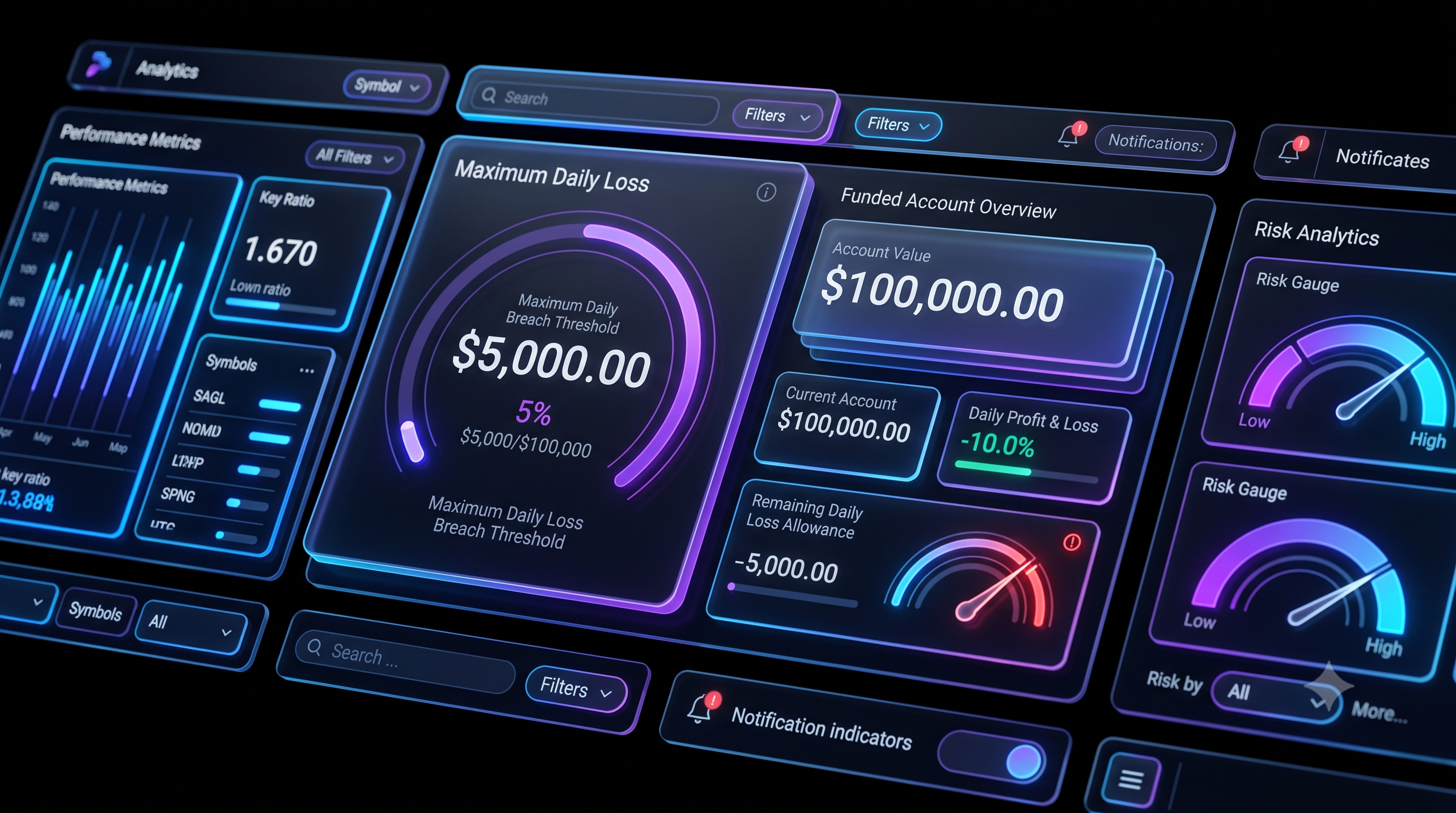
A $100,000 account also doesn't mean a trader effectively has $100,000 available to lose. In practice, the firm's drawdown allowance is often a much more useful number for understanding how much risk capacity an evaluation provides.
This guide explains how prop firm challenge fees and account sizes work, why prices vary, and what beginners should compare before paying for an evaluation.
Quick Facts
What Is a Prop Firm Challenge Fee?
A prop firm challenge fee is the amount a trader pays to participate in an evaluation.
During the evaluation, the trader generally needs to achieve specified objectives while staying within the firm's risk parameters. These can include profit targets, Maximum Daily Loss, Maximum Drawdown, minimum trading days, consistency requirements, and other program-specific trading rules.
Successfully satisfying the evaluation requirements can make the trader eligible to progress toward the firm's funded stage, subject to the program's terms. The challenge fee therefore isn't simply a payment for an account balance. You're paying to participate in a specific evaluation program.
Why Do Prop Firms Charge Challenge Fees?
The exact economics differ between companies, but evaluation fees can contribute to costs associated with operating a prop trading program.
These can include technology, trading infrastructure, platforms, market data, payment processing, customer support, compliance operations, risk systems, and trader evaluation. From the trader's perspective, however, the important question isn't why the firm charges a fee. It's: What do I receive for that fee? Two challenges costing the same amount can offer substantially different conditions.
How Much Do Prop Firm Challenges Cost?
There is no standard challenge price. Pricing varies according to factors such as advertised account size, evaluation model, asset class, drawdown allowance, profit targets, trading platform, firm pricing strategy, and promotions or discounts.
Rather than publishing a single average prop firm challenge price that can quickly become outdated, traders should compare the current price of the specific account they intend to purchase.
For example, you might encounter a hypothetical pricing structure such as:
These figures are illustrative rather than current offers. The important point is that challenge price usually increases with advertised account size, but value doesn't necessarily increase at the same rate.
Understanding Prop Firm Account Sizes
Prop firms commonly market programs using an account's nominal balance ($10K → $25K → $50K → $100K → $200K).
Beginners sometimes interpret this as equivalent to being given that amount of spendable capital. That's misleading.
Imagine you purchase a hypothetical $100,000 evaluation with a 10% maximum loss limit. Your effective total loss allowance might be approximately $10,000 ($100,000 × 10%). Now consider a hypothetical $50,000 account with the same 10% limit: $5,000 ($50,000 × 10%). From a risk perspective, these drawdown allowances are often more informative than the headline account balances.
Why Account Size Can Be Misleading
Consider two hypothetical programs:
Program A advertises twice the account size, but its simplified loss allowance is only $1,000 greater. This changes the comparison substantially. Instead of asking 'How big is the account?', consider asking 'How much usable risk capacity am I receiving for the fee?'
Challenge Fee vs Maximum Drawdown
One useful comparison metric is the relationship between the challenge price and permitted drawdown.
Suppose Challenge A costs $400 for a $100,000 account with 10% maximum loss ($10,000 loss allowance). Challenge B costs $300 for a $100,000 account with 6% maximum loss ($6,000 loss allowance). Challenge B is cheaper, but Challenge A provides considerably more theoretical room before reaching the maximum loss threshold.
That doesn't automatically make Challenge A better, because drawdown type also matters. A static 8% drawdown and trailing 8% drawdown can behave very differently. Price, percentage, and calculation methodology should therefore be considered together.
One-Step vs Two-Step Pricing
Evaluation structure can also influence challenge pricing. A one-step challenge requires completing one evaluation stage, whereas a two-step challenge requires passing two stages before reaching the funded stage.
One-step programs may sometimes command a premium because they provide a shorter evaluation path, while two-step programs can sometimes offer lower upfront pricing. Don't choose an evaluation model based solely on the fee.
Other Fees Traders Should Check
The advertised challenge price may not always represent every potential cost associated with a program. Depending on the provider and asset class, traders may encounter:
- Activation Fees: Some programs charge an additional fee after passing an evaluation or reaching the funded stage.
- Recurring Fees: Certain evaluation models, particularly in futures, use monthly subscription pricing.
- Market Data Fees: Access to specific exchange feeds or data connections can involve extra costs.
- Platform Fees: Specialized platforms or extra add-ons may carry individual charges.
- Reset Fees: Failed evaluations can sometimes be reset or restarted for a separate fee.
- Currency Conversion and Payment Fees: Payment gateways or card issuers may add transaction charges.
Before purchasing, look for the total potential cost, not only the number shown on the challenge card.
Are Prop Firm Challenge Fees Refundable?
Refund policies vary. A firm may refund the fee after a trader reaches a specified milestone, include reimbursement with an eligible payout, offer partial reimbursement, or treat the fee as non-refundable.
Suppose a challenge fee is $400, your first eligible payout is $3,600, and potential fee reimbursement is $400. If terms allow both, you could receive $4,000 in total. However, the reimbursement isn't trading profit—always treat challenge fee refunds and profit payouts as separate features.
Example: Comparing Three Prop Firm Challenges
Imagine choosing among three hypothetical $100,000 programs:
If you choose only by price, Firm C wins. If you choose only by maximum drawdown, Firm A appears better. If you choose only by speed, Firm B looks better. Value depends on which combination fits your strategy.
Should You Buy a Bigger Account?
Not automatically. A beginner may think: 'If I'm going to buy a challenge anyway, I might as well buy the $200K account.' But larger accounts mean higher evaluation fees, larger nominal P&L swings, greater psychological pressure, and more money lost if you repeatedly fail.
Suppose your trading system risks 0.5% per trade. On a $25,000 account, that is $125 per trade. On a $200,000 account, that is $1,000 per trade. The percentage risk is identical, but seeing a $1,000 floating loss can affect a new trader very differently. The best account size is one you can trade without changing your strategy because of dollar amounts.
How Much Should a Beginner Spend?
There is no ideal dollar amount for every trader. A useful principle is: Don't purchase a larger challenge simply because the potential payout looks bigger.
Before paying for an evaluation, ask yourself: Have I tested my strategy? Do I understand the drawdown rules? Can I afford to lose the entire challenge fee? Would failing make me immediately buy another challenge? Am I selecting this account because it fits my strategy or because of the headline balance?
Common Beginner Mistakes
- Choosing the Cheapest Challenge: A cheap evaluation with restrictive rules may be poor value for your strategy.
- Choosing the Biggest Account: A larger headline balance doesn't automatically mean better conditions.
- Ignoring Drawdown Type: A 10% static drawdown and a 10% trailing drawdown aren't equivalent.
- Ignoring Additional Fees: Subscription, activation, data, reset, or platform costs can change the total price.
- Buying Challenges Repeatedly: A $100 challenge purchased ten times costs $1,000. Repeated failures add up fast.
- Buying During Every Promotion: A 20% discount doesn't make an unsuitable challenge right for you.
- Comparing Price Without Comparing Rules: Challenge price should always be evaluated alongside drawdown, targets, platforms, and payouts.
What to Compare Before Buying
PropCompareHub Insight
💡 PropCompareHub Insight: Challenge pricing is useful—but price-to-rules value is much more useful. A $300 challenge isn't automatically cheaper in practical terms than a $500 challenge if its restrictive rules cause you to fail repeatedly. Use PropCompareHub to compare challenge fees, drawdown limits, and rules side-by-side.
Conclusion
Prop firm challenge fees are easy to compare. Prop firm value is harder to compare.
A lower fee can look attractive, while a larger account can make another program appear more valuable. But neither number tells you whether the evaluation actually suits your trading strategy.
Before purchasing a challenge, compare the relationship between Price → Account Size → Drawdown → Profit Target → Rules → Payouts. Most importantly, remember that the advertised account balance isn't the amount you're allowed to lose. Understanding your actual risk allowance—and what you're paying to access it—can help you make a much more informed decision.
Frequently Asked Questions
Related Guides
Prop Firm Rules Explained: 12 Rules Every Trader Should Know
Learn the most important prop firm rules, including drawdown limits, news trading, minimum trading days, consistency rules, payouts, and prohibited strategies.

Prop Firm Payouts Explained: How Funded Traders Get Paid
Learn how prop firm payouts work, including payout schedules, profit splits, withdrawal rules, first payout requirements, processing times, and common restrictions.
Find Your Ideal Prop Firm
Answer a quick question to get personalized firm recommendations tailored to your goals.
Ready to Compare Prop Firms?
Don't settle for the first firm you find. Use our data to find the best conditions for your specific trading strategy.