
Key Takeaways
- Every prop firm has its own rulebook, so never assume rules are identical between firms.
- Maximum Daily Loss and Maximum Drawdown are among the most important limits to understand.
- News trading, overnight positions, Expert Advisors, copy trading, and certain strategies may be restricted.
- Some programs use consistency or minimum-trading-day requirements.
- Evaluation rules and funded-account rules may differ.
- A challenge with a slightly higher price may still be preferable if its rules better match your strategy.
- Always verify current rules directly with the prop firm before purchasing an evaluation.
Passing a prop firm challenge isn't simply about making enough profit. You also need to make that profit without breaking the firm's trading rules.
A trader can reach the required profit target and still fail an evaluation because they exceeded a daily loss limit, violated a news-trading restriction, used a prohibited strategy, or misunderstood how drawdown was calculated. This is why understanding the rulebook should come before purchasing a challenge, not after.
Prop firm rules vary considerably between companies and even between different programs offered by the same firm. However, most evaluation and funded-account programs are built around a similar group of restrictions. This guide explains 12 of the most important prop firm rules beginners should understand, how they work, and what to compare before choosing a funded trading program.
Quick Facts
Why Do Prop Firms Have Trading Rules?
Prop firms use trading rules to control risk and evaluate whether traders can follow a repeatable trading process. An evaluation is therefore testing more than your ability to generate profit.
The firm evaluates whether you can control losses, follow predefined risk limits, avoid excessive position sizes, maintain consistent performance, trade without exploiting prohibited platform behavior, and follow operational rules over an extended period. How you generate the return matters as much as the return itself.
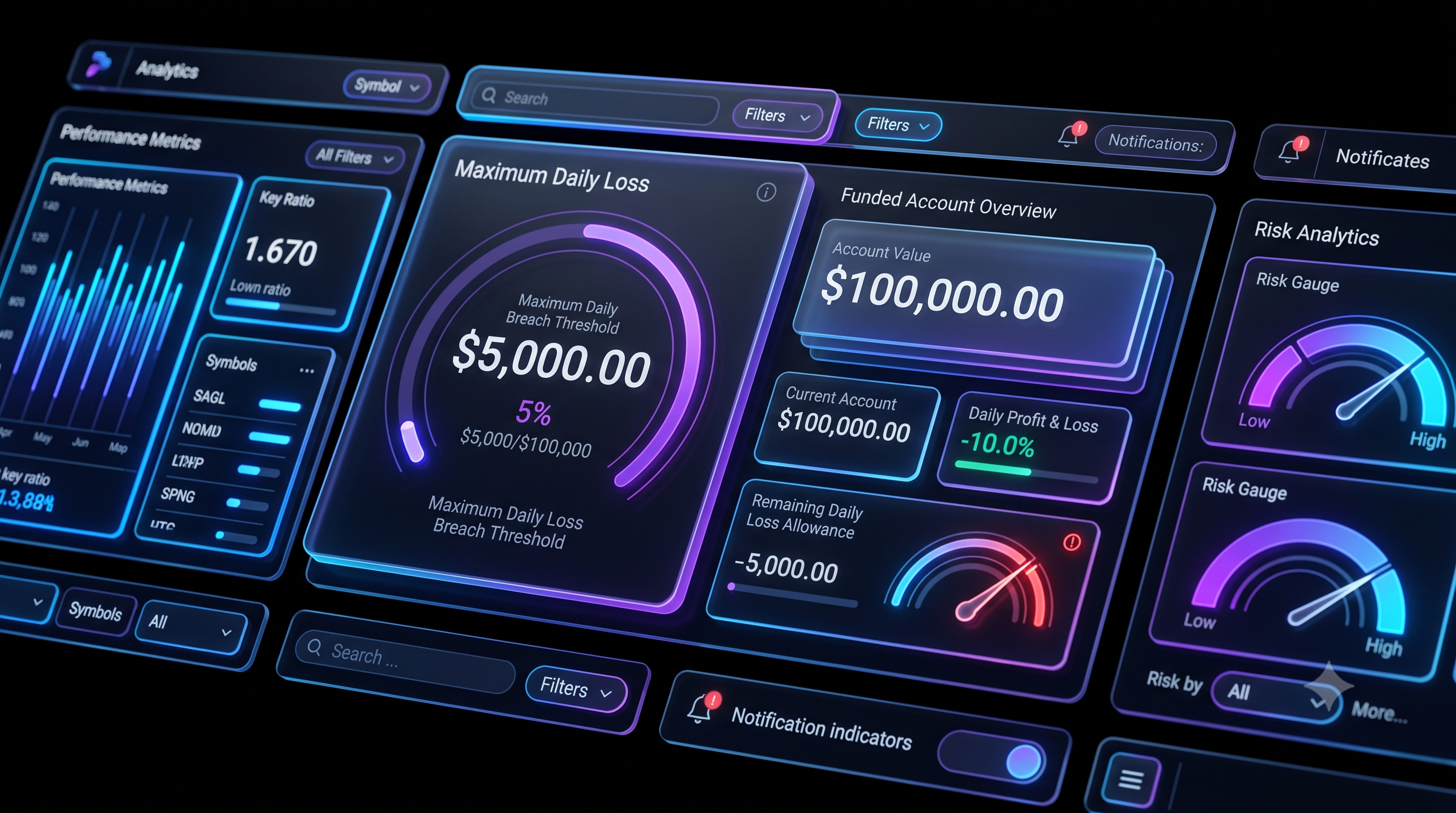
1. Maximum Daily Loss
Maximum Daily Loss limits how much your account can lose during a defined trading day. On a $100,000 account with a 5% daily limit, your daily loss allowance is $5,000 ($100,000 × 5%). Exceeding that permitted amount breaches the evaluation.
Depending on the firm's methodology, daily loss calculations may account for closed losses, floating losses, commissions, swap charges, starting equity, or profits generated earlier in the day. Understanding the calculation method is crucial.
2. Maximum Drawdown
Maximum Drawdown defines the total amount an account is permitted to lose before violating the firm's risk limit. On a $100,000 account with 10% maximum drawdown, the loss capacity is around $10,000.
Drawdown type can matter as much as the drawdown percentage.
3. Profit Targets
A profit target is the return needed to pass an evaluation phase (e.g. 8% on a $100,000 account = $8,000). Treat the profit target as an objective, not a deadline that forces you to over-leverage.
4. Minimum Trading Days
Some evaluations require traders to complete a minimum number of trading days (e.g. 5 days) before passing, even if the profit target is reached earlier.
5. Maximum Trading Period
While historically common, many modern challenges feature unlimited time limits. Programs with 30-day limits can pressure traders into overtrading, whereas unlimited time programs accommodate swing traders better.
6. Consistency Rules
A consistency rule prevents a trader's performance from depending too heavily on a single lucky trade or day (e.g. requiring no single trading day to account for more than 30% or 50% of total profit).
7. News Trading Rules
High-impact economic events (NFP, FOMC, CPI) create high volatility. Firms may allow news trading completely, restrict opening trades 2-5 minutes around events, or apply different rules on funded accounts versus evaluations.
8. Overnight and Weekend Holding
Swing traders must check if positions can be held overnight or over weekends. A program requiring weekend closure could fundamentally conflict with long-term trend strategies.
9. EA and Automated Trading Rules
While many firms allow EAs, automated trading restrictions often apply to high-frequency trading (HFT), platform latency exploitation, or identical signal copying across multiple un-owned accounts.
10. Copy Trading Rules
Copying between your own personal accounts is widely permitted, but copying external third-party signals or participating in mass signal pools may violate account ownership rules.
11. Prohibited Trading Strategies
Forbidden behaviors include latency arbitrage, price feed exploitation, account sharing/passing services, grid trading without stop-loss, and reverse hedging between accounts.
12. Payout Rules
Passing the evaluation doesn't mean the rulebook vanishes. Check first-payout lock-in periods, payout frequency, minimum withdrawal amounts, and scaling conditions.
Evaluation Rules vs Funded Account Rules
Rules on an evaluation phase may differ from rules on a live funded account—especially regarding news trading, weekend holding, and consistency caps. Always read both sets of terms.
Example: Comparing Two Prop Firm Rule Sets
Asking 'Which firm has the easiest rules?' is less effective than asking 'Which rules fit my specific trading strategy?'
How to Compare Prop Firm Rules Before Buying
PropCompareHub Insight
Conclusion
Understanding prop firm rules is one of the most important steps you can take before purchasing an evaluation.
Profit targets attract most of the attention, but rules governing drawdown, daily losses, news trading, overnight positions, consistency, automation, and payouts have a much greater impact on your actual trading experience.
Before purchasing an evaluation, explore [Compare All Prop Firms](/compare), [Best Prop Firms](/best-prop-firms), [What Is a Prop Firm?](/learn/what-is-a-prop-firm), [How Prop Firm Challenges Work](/learn/how-do-prop-firm-challenges-work), or [Static vs Trailing Drawdown](/learn/static-vs-trailing-drawdown).
Frequently Asked Questions
Related Guides
Prop Firm Challenge Fees Explained: What Are You Actually Paying For?
Learn how prop firm challenge fees work, what affects evaluation pricing, how account sizes differ, and what traders should compare before buying a challenge.

Prop Firm Payouts Explained: How Funded Traders Get Paid
Learn how prop firm payouts work, including payout schedules, profit splits, withdrawal rules, first payout requirements, processing times, and common restrictions.
Find Your Ideal Prop Firm
Answer a quick question to get personalized firm recommendations tailored to your goals.
Ready to Compare Prop Firms?
Don't settle for the first firm you find. Use our data to find the best conditions for your specific trading strategy.